

Here is the part that surprises people: most buyers who can write a $2 million check for a hypercar do not write one.
That is not a liquidity problem. It is a capital allocation decision. If your invested capital reliably returns more than the cost of borrowing, financing the car is the mathematically correct move — and the people buying these cars did not get there by making mathematically incorrect moves.
This guide covers how million dollar supercar finance works in practice: which lenders operate at this level, what rates and terms look like in 2026, what qualification actually requires, and the structural traps that catch first-time exotic buyers.
Why Ultra-High-Net-Worth Buyers Finance

Three reasons dominate.
Opportunity cost. Capital tied up in a depreciating asset earns nothing. If a portfolio returns 8–10% and a collector car loan costs 6–7%, the spread favours borrowing.
Liquidity preservation. Business owners and investors frequently have significant net worth with limited uncommitted cash. Financing preserves working capital without forcing an asset sale at a bad moment.
Tax structure. When a vehicle is titled to a business with documented business use, interest may be deductible and depreciation schedules may apply. This is highly situation-specific and requires a CPA, but it changes the maths meaningfully for some buyers.
The Four Types of Lenders
| Lender type | Typical loan size | Terms | Best for |
|---|---|---|---|
| Specialty collector car lenders | $50K – $2M+ | 7–15 years, simple interest | Fast approval, appreciating assets |
| Private banking / wealth management | $500K – $20M+ | Custom, often interest-only | Existing private bank clients |
| Marine & aviation-style asset lenders | $250K – $5M | 10–20 years | Very large single-asset loans |
| Manufacturer captive finance | Up to ~$500K | 3–7 years | New cars from franchised dealers |
Specialty Collector Car Lenders

Woodside Credit and JJ Best Banc are the two names that come up most in the US market. Their defining feature is simple interest with long terms — commonly 7 to 15 years — which produces dramatically lower monthly payments than a conventional auto loan.
A $1.5 million loan over 12 years at simple interest can land under $16,000 per month. The same loan on a standard 5-year amortising structure would be roughly triple that.
The trade-off is total interest paid. Long terms are only rational when the asset holds or gains value, which is precisely why these lenders specialise in collectibles rather than mainstream cars.
Private Banking

Above roughly $2 million, most transactions move to private banking. J.P. Morgan Private Bank, Goldman Sachs Private Wealth, and comparable institutions will lend against a client’s broader relationship — securities portfolios, real estate, or the collection itself.
Structures here are bespoke. Interest-only terms, portfolio-secured lines of credit, and cross-collateralised facilities covering several vehicles are all common. Rates typically track SOFR plus a spread negotiated on relationship depth rather than the car.
The advantage is that the loan may not be secured by the vehicle at all, which keeps the title clean and simplifies later sale or export.
Manufacturer Captive Finance

Porsche Financial Services, BMW Financial Services, and similar captives handle new cars up to roughly $500,000. Beyond that, most captives decline or require heavy structuring, which is why true hypercar purchases rarely go this route.
exotic car lease deals compared
Real Rates and Terms in 2026
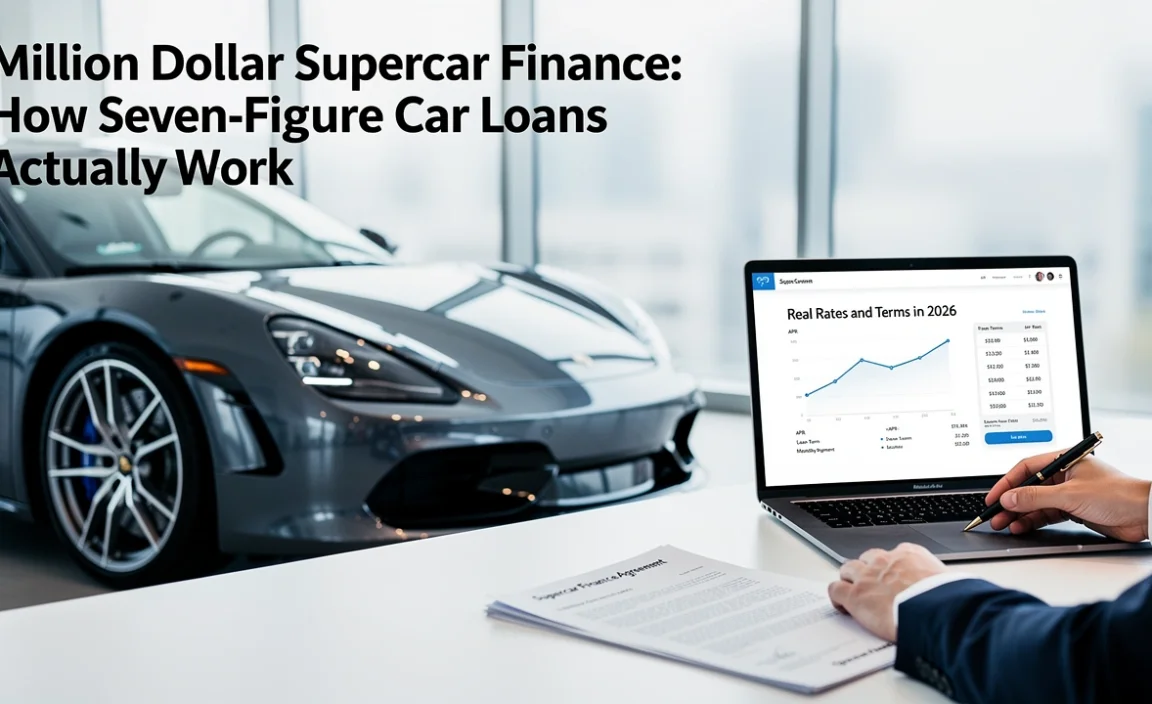
Rates at this level are relationship-driven, not rate-sheet-driven, but the following ranges are realistic for well-qualified borrowers:
- Specialty collector lenders: roughly 6.5% – 9.5% simple interest, 7–15 year terms
- Private banking, portfolio-secured: roughly 5.5% – 8%, often floating
- Asset-based lending against a collection: roughly 6% – 9%, 50–70% loan-to-value
- Captive finance on new exotics: roughly 6% – 9%, 3–7 years
Down payment expectations scale with risk. New, mainstream-exotic purchases in the $300K–$800K range typically require 10–20% down. Seven-figure and one-off cars usually require 20–35%, and lenders may cap loan-to-value at 60–70% on cars without established comparables.
What Qualification Actually Requires

Contrary to expectations, credit score is rarely the binding constraint. Lenders at this level care about four things.
Verified net worth and liquidity. Expect to provide a personal financial statement, two years of tax returns, and often bank or brokerage statements. Some lenders want to see post-purchase liquid reserves covering 12–24 months of payments.
Asset quality. The car matters as much as the borrower. Lenders favour models with established auction comparables, documented service history, and clean title. A one-off coachbuilt commission with no market comparables is harder to finance than a limited-run hypercar with a public sales record.
Clean title and provenance. Salvage history, unresolved liens, or grey-market import complications will stop a deal cold.
Insurance in place. Bound agreed-value coverage naming the lender as loss payee is required before funding. This is frequently the step that delays closings.
Timeline: specialty lenders can fund in 3–7 business days. Private banking structures take 2–6 weeks depending on complexity.
Financing vs. Leasing vs. Paying Cash

Finance when the car is likely to hold value, you want ownership and modification freedom, and you intend to keep it beyond three years.
Lease when you want a specific car for a defined period, expect to rotate into something else, and want to avoid taking depreciation risk on a high-volume model.
Pay cash when the car is a genuine appreciating collectible, you have surplus liquidity, or you want a completely clean title for a future international sale.
For a car expected to appreciate, financing is often the strongest option — you gain the appreciation while paying interest on borrowed capital that would otherwise be deployed elsewhere.
which supercars actually depreciate
Five Mistakes That Cost Real Money

1. Comparing monthly payment instead of total cost. A 15-year simple-interest loan looks cheap monthly and can cost hundreds of thousands more in total interest. Always run the total.
2. Ignoring prepayment penalties. Some collector lenders impose them. If you plan to sell within three years, confirm the payoff terms in writing before signing.
3. Underestimating insurance. Lenders require agreed-value coverage, which on a seven-figure car can run $40,000–$120,000 annually. Buyers who budgeted only for the payment get an unpleasant surprise at funding.
4. Financing a car with no comparables. Unique commissions are the hardest assets to lend against. If financing matters to you, that constraint should influence what you buy.
5. Skipping the pre-purchase inspection to close faster. A $2,000 PPI on a $1.5 million car is the cheapest insurance in the transaction. Undisclosed accident history destroys resale value at this level.
FAQ
Can you finance a million dollar car?

Yes. Specialty collector car lenders routinely write loans above $1 million, and private banks handle transactions well into eight figures. Expect 20–35% down and full financial documentation.
What credit score do you need for a supercar loan?

Most specialty lenders look for 700+, but credit score is rarely the deciding factor. Verified net worth, liquidity, and the quality of the vehicle as collateral matter more.
What are typical interest rates on exotic car loans?

Roughly 6.5% to 9.5% simple interest through specialty collector lenders in 2026, and 5.5% to 8% through portfolio-secured private banking arrangements.
How long are supercar loan terms?
Specialty lenders commonly offer 7 to 15 years using simple interest, which keeps monthly payments low. Captive finance and traditional banks typically cap at 5 to 7 years.
Is it better to lease or finance a supercar?

Finance if you plan to keep the car beyond three years or expect it to hold value. Lease if you want to rotate cars regularly and prefer not to carry depreciation risk on a high-volume model.
The Bottom Line
Million dollar supercar finance is less about access to credit and more about structure. The buyers who get this right treat the loan as one component of a broader capital plan rather than a way to afford a car they otherwise could not.
Three practical steps: get pre-qualified before you shop so you negotiate as a cash-equivalent buyer, bind insurance early because it gates funding, and run total cost of borrowing rather than monthly payment on every structure you are offered.
2 thoughts on “Million Dollar Supercar Finance: How Seven-Figure Car Loans Actually Work”